Saturday, May 14, 2016

Unpacking a Standard
For this activity, we were asked to:
Create a Prezi or emaze presentation to unpack two standards you have chosen. Include the following information in your presentation
-The standard and the source of the standard (e.g., Common Core State Standards, State Standards, or School Goals).
-An explanation of why you chose these two standards.
-The "big idea(s)" in the standards. The nouns in the standard should help you identify the big ideas.
-The verbs in the standard and an explanation of the skills that students should develop in meeting the standards.
-1-2 projects or activities in which you could engage students to know that they are learning the knowledge and developing the skills identified in the two standards
A copy of my Prezi can be accessed by clicking here.
Create a Prezi or emaze presentation to unpack two standards you have chosen. Include the following information in your presentation
-The standard and the source of the standard (e.g., Common Core State Standards, State Standards, or School Goals).
-An explanation of why you chose these two standards.
-The "big idea(s)" in the standards. The nouns in the standard should help you identify the big ideas.
-The verbs in the standard and an explanation of the skills that students should develop in meeting the standards.
-1-2 projects or activities in which you could engage students to know that they are learning the knowledge and developing the skills identified in the two standards
A copy of my Prezi can be accessed by clicking here.
Understanding and Applying Standards
Since the implementation of the Common Core, standards have gotten quite a lot of bad press. Prior to beginning this program, I largely believed what I had heard from (mostly) frustrated parents and failing school districts: standards just don't work. Throughout this program, I have come to see the value of standards in setting up guidelines for lessons, grade levels, and desired achievement outcomes. Without standards, teachers are left to attempt to not only create their own curriculum, but also to set levels for their schools based only on the research they have done. This standardless curriculum leaves us with schools in some states that are outperforming Japan, while other schools fall hopelessly behind. The idea of the Common Core is to set a baseline achievement level where all schools need to be. Of course, schools can exceed Common Core by having a higher achievement goal. The idea is just to make sure that everyone gets at least a certain level of education.
This particular unit has taught me that standards are nothing unless they are broken down and understood. If taken at face value, it is easy to get off track of what the standard is actually trying to achieve. Although all of this week's activities were helpful to me, I think that the one I will use most often and with the most success will be backwards mapping.
Unpacking a Standard
This activity, while clearly meant to get us to understand what is in a standard, seemed like a bit of an odd place to start. While I understand why it was our first activity, I felt a little lost trying to unpack the standards until I started thinking about them in terms of activities, assessments, and overall goals. The one thing that really stuck with me from this activity is to focus on the verbs in a standard. For the standard that I worked with for most of the week, the verb was "identify." I had to keep coming back to that word to make sure I did not stray from the standard. Knowing how to unpack a standard will be especially helpful if I end up teaching subjects with which I am less familiar than, say, ELA.
Backwards Mapping
This activity was by far the most helpful for me. Because I am new to lesson planning and such, working backwards in very helpful. I find it very easy to get off track when I am planning a lesson because there are so many cool things that would be so much fun to teach. Backwards mapping will help me stay focused because it starts with what I wish to accomplish and forces me to stay within the confines of those proficiencies. I will definitely continue to use this method, especially on lessons where very specific objectives need to be met and I am having trouble working forwards to get there. In contrast to unpacking, I think this technique will actually be most helpful for me in ELA. I tend to get so excited about content and discussion that I forget what I was aiming for in the first place. I also liked that it forced me to think about assessments. Formative assessments are somewhat of a new concept for me, largely because of my own educational past. I am still working on learning how to incorporate less formal assessments into my lessons.
SMART Objectives
I found SMART objectives quite helpful in creating objectives that are actually measurable. The other parts of SMART all sort of work together to make sure that the objective hits on what it needs to, but the focus on the ability to measure is something that I think is especially important for me since I am most interested in ELA. Math teachers definitely have it a bit easier when it comes to measurement because answers are either right or wrong. Using SMART objectives makes it easier for me to find a more tangible way to measure understanding of topics that are more abstract than, say, 2+2=4. Overall, I see myself using SMART objectives in the future as a guideline for how to structure my objectives. I think it is something that will become second nature after some practice.
This particular unit has taught me that standards are nothing unless they are broken down and understood. If taken at face value, it is easy to get off track of what the standard is actually trying to achieve. Although all of this week's activities were helpful to me, I think that the one I will use most often and with the most success will be backwards mapping.
Unpacking a Standard
This activity, while clearly meant to get us to understand what is in a standard, seemed like a bit of an odd place to start. While I understand why it was our first activity, I felt a little lost trying to unpack the standards until I started thinking about them in terms of activities, assessments, and overall goals. The one thing that really stuck with me from this activity is to focus on the verbs in a standard. For the standard that I worked with for most of the week, the verb was "identify." I had to keep coming back to that word to make sure I did not stray from the standard. Knowing how to unpack a standard will be especially helpful if I end up teaching subjects with which I am less familiar than, say, ELA.
Backwards Mapping
This activity was by far the most helpful for me. Because I am new to lesson planning and such, working backwards in very helpful. I find it very easy to get off track when I am planning a lesson because there are so many cool things that would be so much fun to teach. Backwards mapping will help me stay focused because it starts with what I wish to accomplish and forces me to stay within the confines of those proficiencies. I will definitely continue to use this method, especially on lessons where very specific objectives need to be met and I am having trouble working forwards to get there. In contrast to unpacking, I think this technique will actually be most helpful for me in ELA. I tend to get so excited about content and discussion that I forget what I was aiming for in the first place. I also liked that it forced me to think about assessments. Formative assessments are somewhat of a new concept for me, largely because of my own educational past. I am still working on learning how to incorporate less formal assessments into my lessons.
SMART Objectives
I found SMART objectives quite helpful in creating objectives that are actually measurable. The other parts of SMART all sort of work together to make sure that the objective hits on what it needs to, but the focus on the ability to measure is something that I think is especially important for me since I am most interested in ELA. Math teachers definitely have it a bit easier when it comes to measurement because answers are either right or wrong. Using SMART objectives makes it easier for me to find a more tangible way to measure understanding of topics that are more abstract than, say, 2+2=4. Overall, I see myself using SMART objectives in the future as a guideline for how to structure my objectives. I think it is something that will become second nature after some practice.
Standards and Backwards Mapping
As an aspiring middle grades instructor, I work especially hard to find standards that are cross-curricular and applicable outside of academia so that students can see their importance. My largest area of interest is English/Language Arts, but at the school I am hoping to work for in the fall, the ELA teacher also teaches at least one section of Social Studies, so I tried to keep the possibility of teaching both of those subjects, possibly to the same group of students, in mind. The standard I ended up choosing is one that has been adapted from an ELA standard to fit with Social Studies.
Common Core Standard
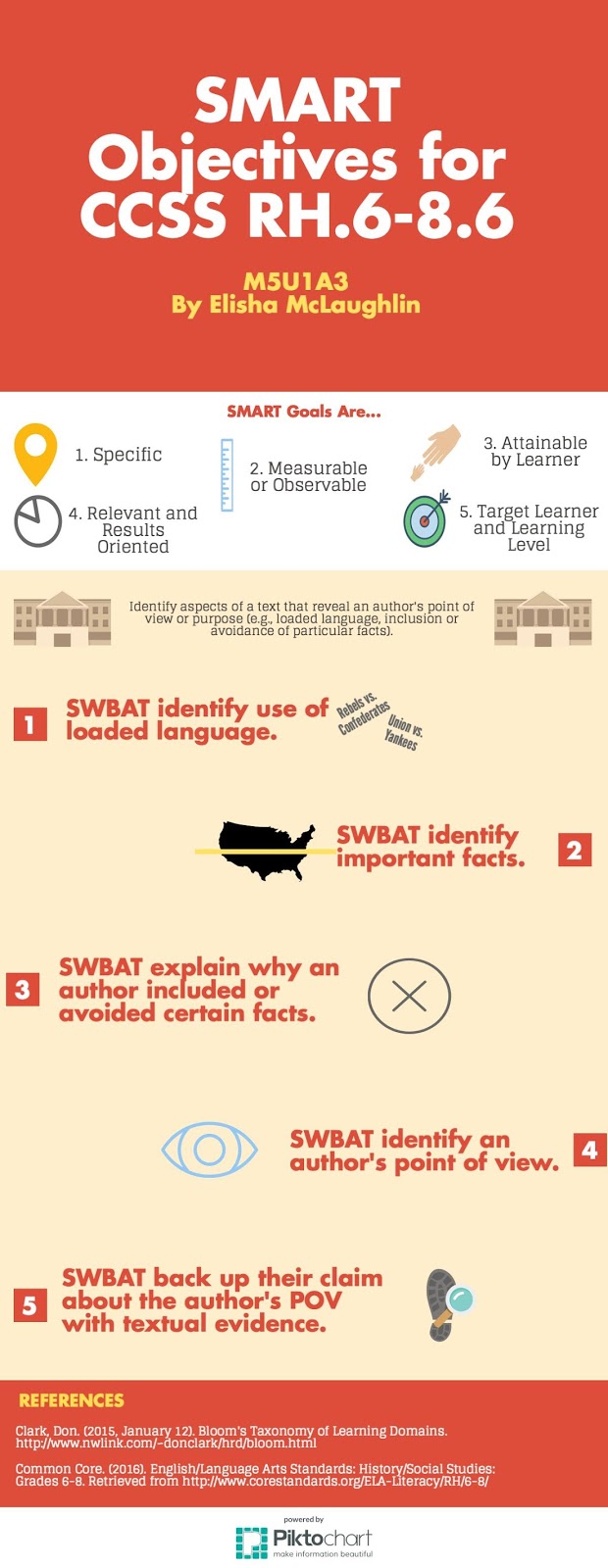
RH.6-8.6: Identify aspects of a text that reveal an author's point of view or purpose (e.g., loaded language, inclusion or avoidance of particular facts).
Reason for Choice
The reason I picked this standard in particular is because it is so important for students to be critical readers and consumers of information. Being able to identify the author's point of view will allow students to notice when an author is presenting a biased view on a topic. This skill is useful whether students are reading about a scientific advancement, a historical event from hundreds of years ago, or the upcoming election. These are all topics that will at some point be relevant to these students, and the ability to critically evaluate the information being presented based on the author's view point is exceptionally important to developing a complete understanding of the topic.
Three Proficiencies, Assessments, and Learning Activities
The proficiencies, assessments, and learning activities below serve as an organized way of tying together everything students need to master in order to be proficient in the standard. Each proficiency will be connected to both one of the assessments and one of the learning activities as to truly make the best use of backwards mapping. For the purposes of this module, the standards discussed will all be taught in a unit on the Civil War.
Three Proficiencies
All assessments will be completed individually.
Common Core. (2016). English/Language Arts Standards: History/Social Studies: Grades 6-8. Retrieved from http://www.corestandards.org/ELA-Literacy/RH/6-8/
Common Core Standard
RH.6-8.6: Identify aspects of a text that reveal an author's point of view or purpose (e.g., loaded language, inclusion or avoidance of particular facts).
Reason for Choice
The reason I picked this standard in particular is because it is so important for students to be critical readers and consumers of information. Being able to identify the author's point of view will allow students to notice when an author is presenting a biased view on a topic. This skill is useful whether students are reading about a scientific advancement, a historical event from hundreds of years ago, or the upcoming election. These are all topics that will at some point be relevant to these students, and the ability to critically evaluate the information being presented based on the author's view point is exceptionally important to developing a complete understanding of the topic.
Three Proficiencies, Assessments, and Learning Activities
The proficiencies, assessments, and learning activities below serve as an organized way of tying together everything students need to master in order to be proficient in the standard. Each proficiency will be connected to both one of the assessments and one of the learning activities as to truly make the best use of backwards mapping. For the purposes of this module, the standards discussed will all be taught in a unit on the Civil War.
Three Proficiencies
- Identify loaded language used in a text that supports the author's point of view.
- Identify instances of inclusion or avoidance of facts that support the author's point of view.
- Compare and contrast two texts on the same topic and determine differences in point of view.
All assessments will be completed individually.
- Formative Assessment: Students will be given a short text on the Civil War written from the perspective of an African American slave and will be asked to underline instances of loaded language and include annotations explaining how they knew the language was loaded. Students will be asked whose perspective the passage was written from, and they will be expected to use textual evidence to support their claim.
- Formative Assessment: Students will be given a short text written from the perspective of Abraham Lincoln on the Civil War and will be asked to underline instances facts being included AND left out and include annotations explaining the author's choices. Students will be asked whose perspective the passage was written from, and they will be expected to use textual evidence to support their claim.
- Summative Assessment: Students will be given two passages written from different perspectives and will be asked to 1) identify instances of loaded language, 2) inclusion/exclusion of facts, and 3) the perspective of each passage. Students will be asked to conduct a short essay explaining how the passages are similar, how they are different, and how the students knew which perspective each passage was written from. Special attention will be paid to the ability to identify an author's point of view when comparing two different texts with different points of view.
- Students will work in small groups to identify loaded language in a passage about the Civil War written from the perspective of a Confederate soldier that discusses the reasons the war started and who was good/bad in the war. They will underline instances of loaded language and include annotations explaining how they knew that the language was loaded.
- As a class, students will read a factual, largely unbiased account of the Civil War and discuss which facts are included in the passage, paying special attention to any facts that make one side sound especially good or bad. Then, students be broken into pairs to read a passage written from the perspective of a Union soldier. Students will then identify key facts that were included in the second passage or left out and will explain why the author chose to include or leave out specific items.
- As a class, students will create a list of facts and instances of loaded language that support each of the following perspectives: Union soldier, Confederate soldier, African American slave, and Abraham Lincoln. Students will discuss similarities and differences between each of the perspectives.
Common Core. (2016). English/Language Arts Standards: History/Social Studies: Grades 6-8. Retrieved from http://www.corestandards.org/ELA-Literacy/RH/6-8/
Saturday, May 7, 2016
De-Escalating Aggressive Student Behavior
The following is a link to a Prezi I created with my classmates Stephan Beck and Sharon Weaver on de-escalating aggressive student behavior. The presentation includes storyboards to illustrate the situations.
Click hereto view the Prezi!
Click hereto view the Prezi!
Reflecting on Concerns/Fears
When it comes to managing behavior
in my classroom, and I think I am very on-paper prepared for most of what can
be thrown my way. This module did a great job introducing us to different
things that could happen in our classroom. After completing all of the
activities in this module and working with my cohort members to bounce ideas off
of each other, I feel relatively confident in my theoretical understanding of
behavior monitoring. Setting up classroom norms, rules, and procedures is
something that I feel especially confident in, and I think that if I could do
that well, a lot of potential behavior issues will be stopped before they even
have a chance to begin.
My biggest
concern heading into teaching is that all of my preparation with classroom
management is theoretical. I guess it is something that you have to learn as
you go during your first year or so of teaching. To a point, I feel like I know
a lot of what not to do, but I do not yet know what will work with my teaching
style and with my individual students. I think that I am well prepared for
students who have mild to moderate behavioral difficulties, but I cannot
imagine having to figure out solutions for a student who, say, throws chairs
across the room. I was at an interview recently, and another one of the
prospective teachers was telling me about one of her students who regularly
throws chairs and turns over tables, and she only taught elementary school!
Because I am going to be teaching middle school, a student throwing large items
is all the more dangerous. I am not quite sure how I would handle something
like that that is ongoing. This module has prepared me for single incidents of
severe problem behavior, but I am worried that I am underprepared for more
long-term severe issues. I am not sure there is really a way to feel completely
prepared for something like that though, especially since each case is so
different. I think that as long as I approach situations that make me feel
uneasy with confidence and I use the strategies we have learned in this unit, I
will be able to successfully monitor behavior.
As far as
professional development is concerned, I plan to do some classroom observation
for the rest of the school year and to work with my soon-to-be mother-in-law,
Lisa, who teaches seventh grade English over the summer to develop a
comprehensive plan for my classroom. I have already started my observation, and
I can so for sure that establishing expectations early on is important, as is
having a positive relationship with students. By observing a middle school
classroom, I can see first hand techniques that do and do not work with that
age group. I also can get some practice handling minor behavioral issues since
I will be helping in the classroom while I am observing. Once the school year
ends, I am going to work closely with Lisa to develop exciting lesson plans,
discuss behavioral expectations, and prepare an organizational system that will
help keep my first year on track. Having someone I am close to as a mentor is
fantastic because I feel completely comfortable sharing my concerns and
expressing new, different ideas that I think could help students. It is so nice
to have someone who has been through this before to talk to about what to
expect and to help prepare me for my first year. Additionally, I would like to
work closely with other teachers at the school where I will teach to get an
idea of different ways they approach behavioral expectations and monitoring.
Because different teachers have different styles that work for them, I would
like to get as many ideas as I can before I head into my own classroom. Things that
work for one teacher may not work for me, even if we have the same student, and
that is okay. I have to be flexible and willing to adapt based on my own style,
my relationship with my students, and the overall climate of my class. I also
would like to have a mentor observe my classroom once I get into the swing of
the year to give me pointers on how to improve my behavioral monitoring,
whether that is a mentor at my school or a virtual mentor through Teach-Now.
While I am
nervous about being a first year teacher, I am very excited to get to put all
of the things I have learned into practice. Having a theoretical understanding
of being a teacher is great, but until I get into the classroom, I will not
know which strategies work best for me. I am really looking forward to finding
myself as a teacher and to developing strategies that work for me. I know that
the first few years will be the most difficult of my teaching career, but I
also think they give me the most room for growth and learning. Of course, I
will be learning throughout my career, but these first few years of teaching
will set the framework for the rest of my life. One thing that I hope to
remember is that everyone was a first year teacher once, and they all got
through it. Teaching is what I love, and I cannot wait for all of the
challenges that come along with it.
Applying Positive Behavior Interventions and Support
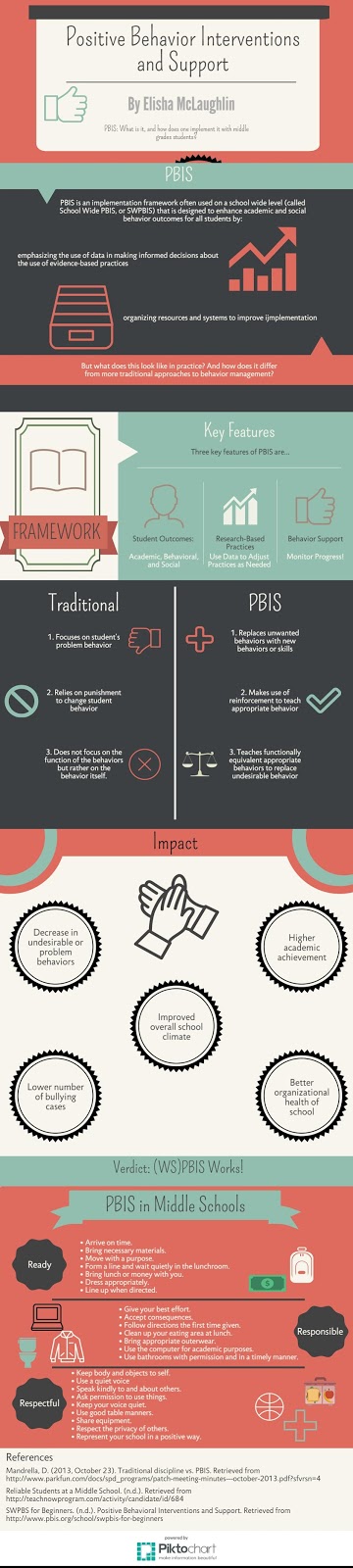
In this activity, I explored Positive Behavior Interventions and Support as a behavior monitoring method. The following infographic depicts the most important information about PBIS as a system and explores the types of expectations that would be set up in a middle school when using this system. To see a larger version of the infographic, click here.
Subscribe to:
Posts (Atom)