The
following behavior evaluation checklist would be most useful with a student who
has trouble with organization and staying on task. A student with ADHD may
benefit from the use of this behavior chart in conjunction with other
interventions because it will help the student understand and reflect on their
behavior. This chart would be used in a middle school for students who change
classes throughout the day. At the beginning of each day, the student would be
given a copy of the student version of this checklist. At the end of each class
period, the student would be required to fill out the checklist for that
period, giving him- or herself one point for each skill successfully
demonstrated. At the end of the day, the student will compare his or her
perceived score with the score given by each teacher and will write a
reflection on the discrepancies between the scores and how he or she can
improve. The student will then bring both copies of the chart home to get
parent initials. This will help keep parents in the loop. Each day, the student
would be required to turn both charts in to the person heading up their
behavioral intervention (likely a school psychologist or guidance counselor).
To help
be consistent throughout the student’s life, the parents will be asked to fill
out a version of the checklist created based on issues the child has at home
that mirror the issues at school. The parents will be asked to fill out the
checklist at least a few times per week and to bring the filled out checklists
to meetings with the teacher or psychologist monitoring the behavior plan. This
will help parents be more aware of their child’s progress and will help the
school see if behavior is generalizing to other settings. Additionally, if the
same behaviors are monitored at school and at home, this will help the student
become consistent with his or her behavior.
Each of
the student’s teachers would need to be involved in this process, especially at
the beginning. A checklist like this would help determine if the student’s
behavior is generalized to all classes or if it is specific to just one class.
Teachers would, of course, be invited to give more detailed feedback, but this
chart allows for a more streamlined, every day solution. Teachers would have
access to the entire behavior evaluation and would, ideally, collaborate with
other teachers to make sure that behavior expectations are consistent across
classes.
This chart could easily be adapted
to an individual student’s specific difficulties. Maybe a student always
completes his or her assigned work, but he or she often gets into physical
confrontation with other students. Each of the behaviors listed could be made
more specific or completely changed to fit individual students. One of the most
important pieces of this behavior chart that would remain constant in all
variations is the part requiring student reflection. If the student can reflect
on his or her own behavior, he or she is well on the way to being able to
monitor his or her behavior. Ideally, the student would eventually be able to
stop using this chart once the student becomes more aware of the behaviors that
are causing issues and learns to monitor them.
For more ideas for behavior checklists and charts, visit my Pinterest! Click here.
Behavior
Evaluation – Teacher
Student
Name:
Date:
Class Period
1
2
3
4
5
6
7
Prepared for class with all materials
In seat at bell
Used inside voice
Followed directions
Respectful to teacher
Respectful to classmates
Raised hand
On task during work time
Completed assigned work
Teacher’s initials
Total points
Total
points for the day:______
Behavior
Evaluation – Student
Name:
Date:
Class Period
1
2
3
4
5
6
7
Prepared for class with all materials
In seat at bell
Used inside voice
Followed directions
Respectful to teacher
Respectful to classmates
Raised hand
On task during work time
Completed assigned work
Teacher’s and parent’s initials
Total points
Total
points for the day:______
Did
I reach the same point totals as my teachers?
If
not, where were our scores different?
What
can I do to improve in areas that I did not receive points?
The following is an analysis six teachers and their classes, specifically focusing on the application of norms, rules, and procedures. Because I am not yet in the classroom, I was given the option of watching the following videos and analyzing the teachers I saw.
Episode 1
Episode 2
Posting of Rules and Procedures
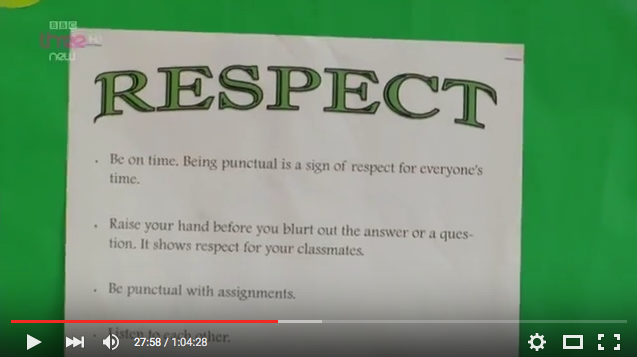
None of the six teachers in “Tough Young Teachers” had rules or procedures posted at the beginning of the year. However, because she struggled controlling her class, Meryl ended up posting something on respect.
Organization of the Classroom
Of the six classrooms in the “Tough Young Teachers” videos, two of them (Claudenia and Chole’s rooms) had students are seated at tables that are arranged with sort of a border and then some more tables in the middle. The tables along each side face the middle of the classroom while the other tables all face the front. For students seated at tables on the sides, it may be difficult to focus on the front of the room if something interesting is going on directly in their natural line of sight. This arrangement may also make it more difficult to arrange for group work situations unless tables are rearranged.
Oliver and Meryl both arranged their classrooms with tables facing the front of the room. While this is very conducive to lecture-style classes, this can sometimes discourage student interaction or, as one can see in the video, encourage students to turn around to talk to their friends which is even more distracting to other students than talking may be otherwise. Oliver also had his students at individual computer workstations for quite a while. This can cause behavior problems because computers make it especially easy for students to get off task. However, if used appropriately, this technology could really enhance the lessons that Oliver is teaching.
Charles arranged his desks in table groups for a large portion of the semester, and then he switched to a set up more like that of Claudenia and Chole’s rooms. Having students sit in table groups is ideal for group work because students are pre-grouped and each have their own space. Behaviorally, this may encourage more talking that is desired, but most table arrangements run into that issue.
Finally, Nicholas had small tables all facing the front of the room that could each fit two students. While this set up may encourage talking in class because a partner is right there, it is especially helpful when assigning partner activities. It also minimizes the number of talking partners a student has which can be helpful for students who just get overwhelmed and want to talk all of the time.
Student Activities
In most of these classroom, teachers spent most of the class period lecturing. This did not necessarily mean that the students were quietly listening, but that was generally the goal. A few of these teachers assigned individual work throughout the semester, but I did not see any group or partner work. In Oliver’s class, students often worked on individual projects on the computer. He had them write summaries of concepts so that everyone was on the same page. In Charles’s class, students were required to take a test right before their fall break to assess their progress. Students did a good job of being quiet during testing procedures. Claudenia tried to do a few whole class activities. While this strategy worked wonders with her seventh graders, her eighth graders were having none of it, so she had to adjust accordingly. I was especially impressed with her initial lesson for her seventh graders. It was engaging, and it incorporated a volunteer, all while teaching lab safety. She showed students how different gases explode when they interact with fire. This was a memorable lesson, and starting out on such a positive note is something I hope to do in my own classes. In Nicholas’s class, he came up with a fun way to get students invested in their own education. He told his students that the school was considering extending the school day by two hours. He asked them to write a letter to the head of school to convince her not to do that. He then chose the five best letters and actually gave them to the head teacher, and she came to the class to tell them how impressed she was and that they need not worry about the school day being extended. His creativity kept his students engaged, and that seems to have had a positive impact on student behavior. If students are engaged in the material, there is less time for them to get themselves into situations that can get them into trouble.
Student Interactions
For the most part, student interactions with each other were either minimal or extremely disruptive. There was not a lot of middle ground. It seemed like the more respect a teacher commanded in their classroom and the more well-liked the teacher was, the less students talked to each other in these video segments. In the less controlled classes like Meryl’s, student interactions were out of control. Students were throwing things at one another and hitting each other. They swore and were just blatantly rude to one another. In Charles’ class, student interaction was hindered by a particularly disruptive student (more about him in the section on student misbehavior). I think students were just so happy to get a chance to actually learn something when he was out of the classroom that they did not even bother to interact with one another. Additionally, I think Charles made students feel like talking to each other was always disruptive.
Student Misbehavior
Student misbehavior was a problem to varying degrees for each of these teachers, just like it is for every teacher. No class is going to be perfect, so teachers need to be prepared to deal with this misbehavior in a constructive, effective manner. The following are instances of student misbehavior that I observed in all six classes and how each teacher handled the misbehavior.
Charles: From the beginning, Charles had trouble dealing with students talking out of turn. He got frustrated when students did not put forth 100% effort and talked to their neighbors. Although I understand where he was coming from, his frustration really shown through. Had he kept a cool, collected exterior, he may have been able to avoid some of the problems he had with one particular student because he would have gained respect earlier on. Charles’s biggest issue was a boy named Caleb. Caleb and just been readmitted to the school after attending a reform school. He was loud, defiant, and disruptive. One example of his behavior shown in the film was when the class was watching a film, Caleb and his friend, Joel, were talking and disrupting the class. Instead of handling the situation in a way that could redirect the boys or actually address the issue, Charles quickly kicked both boys out of the classroom. Of course, there was a history of behavior problems with both of these boys, but I think he could have handled this in a way that was more beneficial to everyone involved. He did, however, bring the boys back into the classroom and have a conversation with them that, although a bit heated, was productive. The boys were honest, if a bit rude, about why they do not like the class. However, after this conversation, Charles literally said that he “didn’t care about them because they didn’t want to learn.” I think that is a horrible mentality as a teacher. I do, however, understand that they were affecting other’s learning. I think Charles needs to adjust his approach to problem students. Later, when Caleb refused to write his homework in his planner, Charles had him stay after class. He started out frustrated, which I think led to a bigger issue with Caleb. He asked that Caleb write the homework because it is a simple issue of respect, and Caleb said that respect is something that is earned. I think that if something like this happened to me, I would seek help. I feel like it is time for Charles to get someone’s advice. He let this go a little too far. Additionally, I think Charles relies too heavily on sending students out of his classroom. There are so many other classroom management strategies, and Charles skipped straight to one that ultimately deprived the student of the chance to learn. As a side note, the administration did eventually intervene in the Caleb situation. Charles was not the only teacher to have problems with Caleb, so bumping that up to an administrative level seemed appropriate.
Claudenia: Claudenia had a great first class with her younger students. However, when her eighth graders entered the room, it was a bit of a different story. Students in her older class were a bit defiant. They did not seem to want to learn, and they did not seem to respect her. Students talked out of turn, and despite intervention from another teacher, students would still not listen to her. They seemed frustrated because they did not understand what she was trying to teach them, so they were angry with her. Despite trying her best, she could not get them completely under control in that class period. She did, however, later succeed in creating an environment conducive to learning by being more of a stickler about rules. Claudenia’s students were especially off-task in transition. This is something Claudenia could work on by employing the use of a timer to get her students to feel the pressure. She did impress upon them that their behavior was not acceptable, but she did not actually come up with a plan to change their behavior. Claudenia did have one especially difficult situation to deal with when her student, Alfie, drew a naked woman on his name tag. She did not know what to do, so she asked some of her fellow teachers about the picture. Some of them told her that it was not a big deal and to let it go, and others told her to confront Alfie. Ultimately, she went with her gut and pulled Alfie aside to discuss this behavior. I like that she asked other teachers what she should do about her problem. I also think she did the right thing confronting Alfie about his drawing, especially since he was only eight years old. She explained to him that this type of drawing was not appropriate, and that if she saw anything like that again, she would have to call home.
Oliver: Oliver had a much less actively disruptive class. However, the students in his lower level class were quite apathetic when it came to their learning. They were not motivated, and Oliver began to feel very downtrodden. After an observation by one of his superiors, he made some changes to his class, focusing on one term at a time and implementing a writing procedure that allowed students to reflect on what they had learned. Oliver did a great job meeting his class where they were and ultimately minimizing behavior problems.
Meryl: Meryl had, by far, the most trouble managing behavior of all of the teachers. At the beginning of the year, the students just did not want to do the work. They were not acting out, but they were also not doing their assigned work. Eventually, this refusal to work turned into misbehavior that quickly escalated. Because of misbehavior in class, Meryl gave out detentions, which she planned to use to improve students’ writing by getting some one on one time with them. Ultimately, only one of the students showed up for detention, and the one who did show up did not even stay. Later, students were throwing things at each other and out the window and completely out of control. Meryl really did not handle it. She did not address behavior issues other than to tell the students to open their books. Throughout the semester, student behavior kept getting worse and worse. At one point, students were hitting each other with the blinds, drawing on each other, and swearing. Support staff and other teachers were brought in to try to help, but Meryl was still unable to get her class to behave in an appropriate way. Meryl really did not seem to have any idea how to control a class. She really started off on the wrong foot, and she could seem to turn it around. Meryl largely just yells at her students rather than constructively dealing with issues. If she took the time to actually talk to her students and create norms, rules, and procedures along with them, maybe she would have an easier time getting them invested in their own behavior.
Chloe: The videos did not show a lot of Chloe’s classroom. The only instance of misbehavior that was shown was painted as relatively out of the ordinary. After the lesson had started, students were facing the wrong direction and one still had his jacket on. Chloe addressed the problem by calling the students out, and then moved on. Her students seemed to understand what was expected of them, and she ultimately was able to continue with class after a bit of a prolonged conversation with the students who were not following the behavior expectations.
Nicholas: Overall, I think I was most impressed with Nicholas in the way he handled his class. He had a few instances of misbehavior early on, but he developed a rapport with his students by using positive feedback, so I think that really minimized the issues he had. The one larger problem he had earlier on had to do with motivation. His student, Rebecca, was off task. She did not understand negative numbers. He asked if she had actually tried to understand, and she said no. He then offered her an explanation using an example of being underwater. He did so without getting frustrated or raising his voice. Rebecca ultimately did her work, and Nicholas had very few issues with students after that.
Withitness
Only around half of these teachers exhibited withitness as far as I could see in the videos. Claudenia, Oliver, and Nicholas were the three who, by the end of the semester, seemed to have found the withitness deep inside of them. Claudenia took a strict approach with her students, commanding respect by just being a presence. She new what was going on in her classroom, and she did not stand for behavior that was out of line. Nicholas, in contrast, took a more lighthearted approach to his classroom, and withitness seemed to come very naturally to him. He seemed to know everything that was going on in his classroom and to be able to keep up with everything almost effortlessly. Obviously, it was not effortless, but it did seem more natural to him. It seemed like he implemented norms, rules, and procedures in a way that made the students feel empowered while still ultimately being the one in charge of the classroom. Both Claudenia and Nicholas positively impacted student behavior with their approach to teaching and classroom management. Both of them intervened in situations before they got out of control, and they seemed to have prevention strategies in place. Oliver took a bit longer to exhibit withitness, but he ultimately is a great example of how withitness changes student behavior. His students went from apathetic and goofing around to studious, serious learners.
The other three teachers were a bit of a different story. Chloe was a bit difficult to judge on this aspect of teaching because we saw so little of her classroom. She seemed to really let things get to her though, which can definitely impact student behavior. Charles and Meryl, however, are both relatively poor examples of withitness. Charles, although attuned to what was happening with his problem student, seemed to kind of forget about the rest of the class. He did not seem to understand that his actions towards Caleb ultimately affected the rest of the class, making them less likely the participate. There seemed to be more fear of Charles than respect for Charles coming from his students, and he did not seem aware of that at all. Meryl could not keep it together in her classroom. Her students were completely out of control, and she often yelled at them. I think she ultimately let their behavior go for too long at the beginning of the year, so students saw her as the kind of teacher that they could walk all over. She did not seem aware of what was happening in her room until it was too late. This is something I hope to avoid by creating solid norms, rules, and procedures at the beginning of the year along with my students so that we are all on the same page and all equally invested in upholding the established rules.
Memorable Strategies
As I mentioned above, two of the positive strategies that stuck out to me came from Claudenia’s classroom and Nicholas’s classroom. Claudenia started off on the right foot with her seventh graders by creating an engaging, informative lesson that would really stick with the students. Because her lesson involved fire and small explosions, she was also able to incorporate a discussion of rules regarding safety into her lesson. This would work less well with a subject like English, but I still would love to try having a big, memorable moment in my first class period. Nicholas’s strategy that stuck out to me was his general approach to teaching. He was so positive and energetic with his students, and using positive feedback and reinforcement is something I would really like to implement into my own classroom. Of course, in an ideal world, that would be all I would need, but I will ultimately have to deal with behavior issues that require more direct intervention.
The two strategies that stood out to be as being the most negative were Charles’s strategy of sending kids out of class and Meryl’s strategy of ignoring problem behavior and yelling about it later. Sending kids out of class ultimately deprives them of the chance to learn, and that is never something I want to do as a teacher. My job is to get all of my students to learn and to like doing it, so I think that would be a last resort sort of strategy for me. Meryl’s strategy would probably be more accurately called a lack of strategy. I think her goal was to ignore problem behavior, but that only works if 1) it is an attention seeking behavior and 2) if you are truly able to place to behavior on extinction no matter how out of hand it gets. Meryl approached her class’s misbehavior in a completely ineffective way, and it might end up costing her her job. The second episode kind of left us hanging on that. My goal is to get ahead of things that could turn into larger problems later down the line. I think her thought process was a sort of “don’t sweat the small stuff” mentality, and that is something that just does not fly at the beginning of the year when you are trying to set the stage for behavior expectations for your class.
Wow! What a neat way to teach physics! This is a great
example of project based learning, and students seem to be very invested in
creating their roller coaster. I am very impressed with how creative this
teacher is, and I hope to be able to channel this much energy and creativity
into my class. I also noticed that these students are incredibly well spoken
and the dialogue between students is at a very high level. Students are using
scientific words and are communicating effectively.
Academic Expectations
Ms. Migdol has high academic expectations for her students.
This is shown through the dialogue between the students and the vocabulary that
individual students are using. It is obvious that using technically sound
vocabulary is a point that has been stressed to these students, and it is nice
to see that the students seem to actually understand the words that they are
using as opposed to shoe-horning the words in because they know it is what
their teacher wants. The idea of “chimers” also helps create high academic
expectations because students are expected to be able to chime in with the
issues that their group has had when working on this activity and to be able to
assist other groups in fixing their problems. I am impressed with how
comfortable the students seem, both with the material and with each other. Of
course, because this class has been with Ms. Migdol for quite some time (from
what can be gleaned from the video), we do not see the academic expectations
being set. We do, however, see them playing out quite nicely.
Behavioral
Expectations
Behaviorally, these students are stellar. This, of course,
means that Ms. Migdol did an excellent job setting up these expectations in
advance. When individual students were talking, the other students actively
listen and responded with constructive, well thought out responses. All of the
students were actively engaged, whether they were speaking or not.
Additionally, students moved from task to task with little to no distraction. I
was very impressed, and I would like to know what kinds of strategies Ms.
Migdol used in establishing these expectations.
Norms and Procedures
As far as norms and procedures are concerned, this
particular video did not establish much. “Chimers” are clearly a norm for this
class, and the procedure of actively listen is well-established. Additionally,
because the transitions are so smooth, I imagine that some sort of procedure
was set up in advance to create such a flawless transition.
Video 2: 3rd
Grade Chinese Math
I am not sure I like this approach. It seems like the
students are just reciting multiplication tables (I think that is what they
were doing), and I know from experience that the ability to recite does not
equal understanding. This parroting is a basic level of understanding, and I
feel like students may have trouble recalling multiplication facts outside of
the “chant.”
Academic Expectations
The academic expectations in this video were a bit unclear
to me. The goal of the class, it seemed, was to be able to recite
multiplication tables. This, however, is not a terribly effect way to
understand math. Sure, these students may be able to answer math questions on
an exam, but what will happen to when they need to apply this knowledge in the
real world?
After reading the article, “Explainer: what makes Chinese
maths lessons so good?,” I felt a bit clearer about the expectations. In China,
students participate in a rigorous, nine year math course that consists of four
stages: “number and algebra”, “space and graph”, “statistics and
probability” and “practice and applications.” Although this program is
rigorous, if this lesson is any indication, I am not sure if it would be
terribly effective outside of a testing environment. However, the expectation
of outstanding test performance is set high and is met by many students.
Behavioral
Expectations
Behaviorally, students seemed to just be expected to parrot
the teacher for most of the lesson. However, once the teacher asked for
volunteers, there was a large amount of side conversation going on. The teacher
ignored it, so I assume this is normal for her class. Overall, the behavioral
expectations did not seem terribly high. As long as students weren’t
exceptionally disruptive, the teacher just continued with her lesson as if the
kids were not talking. Ideally, higher behavioral expectations would be set so
that learning potential could be maximized.
Norms and Procedures
The norms and procedures in this video were pretty clear.
One norm was reciting multiplication tables. The procedure for that is students
sit on the floor in front of the teacher and recite together whichever table
the teacher chooses. Students seemed to be best behaved when enacting this
procedure. Perhaps more procedure would be helpful in raising behavioral
expectations.
Video 3: Whole Brain
Teaching
Whole brain teaching is overwhelming. Honestly, as a
student, I would really dislike something like this. For me, I need to be able
to focus on learning the material, not on learning a bunch of movements that
might eventually help me remember the material. That being said, I am going to
try to have an open mind as I conduct my research on whole brain teaching.
Academic Expectations
I am not sure exactly how whole brain teaching helps academically.
To me, it seems like a lot of parroting and little to no application of
material. The ability to repeat what someone has told you does not mean you
have learned the material. I nanny a three year old on occasion, and he can
sing the ABC song. Does this mean he knows the alphabet? No, not at all. He
cannot recognize letters or sing the song slower than he originally learned it.
My biggest concern with whole brain teaching is that it will lead to the kind
of learning that is only useful on the test. That being said, all of the
students are able to parrot correctly, from what I could tell, showing that
whole brain teaching at least has that level of academic expectations. Overall,
the research on whole brain teaching seems almost too good to be true. I would
like to see more research on students applying the concepts they learn via
whole brain teaching in different settings and in real life.
Behavioral
Expectations
I was actually very impressed with this class behaviorally.
I am surprised that whole brain teaching works so well with older students. It
seems to me that they would feel talked down to, but from what I could tell,
that was not the case at all. In fact, it looked like they were enjoying the
lesson. They all were respectful of the teacher and of each other. I think that
because the lesson was so high energy, students had less time to think about
acting out behaviorally. Overall, I would say that behavioral expectations were
high for this group.
Norms and Procedures
Where do I begin? Whole brain teaching is all about norms
and procedures. The general norm seems to be “repeat whatever the teacher
does.” Some offshoots of that include teaching each other and repeating with
actions. A few procedures shown in the video include speed-reading and teaching
each other. When the students did speed-reading, they were reading sight words,
according to the comments on the video. This seems like it would be effective,
but it ultimately seems a little young for this group of students. When the
students taught each other, the procedure involved parroting what the teacher
had just taught them It concerns me that the students did not even rephrase
what the teacher said, but rather repeated everything word for word and gesture
for gesture.
Setting High
Performance Expectations in My Classroom
Ideally, my approach will look the most similar to that in
the first video about project-based learning. I liked how engaged the students
were with the material, and I would like to find a way to incorporate that into
my own classroom. One thing that I would like to implement from whole brain
teaching is the sheer energy that the teacher brings to the classroom. If the
teacher is that excited, it has to be really hard not to care about the topic.
In my classroom, I will establish high standards early and develop norms and
procedures along side my students to create a respectful, upbeat environment
that is conducive to learning. In order to reach all of my students, I will use
differentiated instruction. Students are often on such different levels that it
is important to plan ahead for the need for differentiation. Behaviorally, I
will expect my students to follow the norms and procedures we came up with as a
class, and I will hold them to that. I will use transition techniques like we
learned about in the last module to help my students successfully keep up this
standard of behavior even when we are moving from one activity to another.
Ideally, I will use a blend of the many approaches we have learned about to
create a classroom environment that leads to learning and respect.